
The Broken Mirror - What if our selfies reveal more than we think?
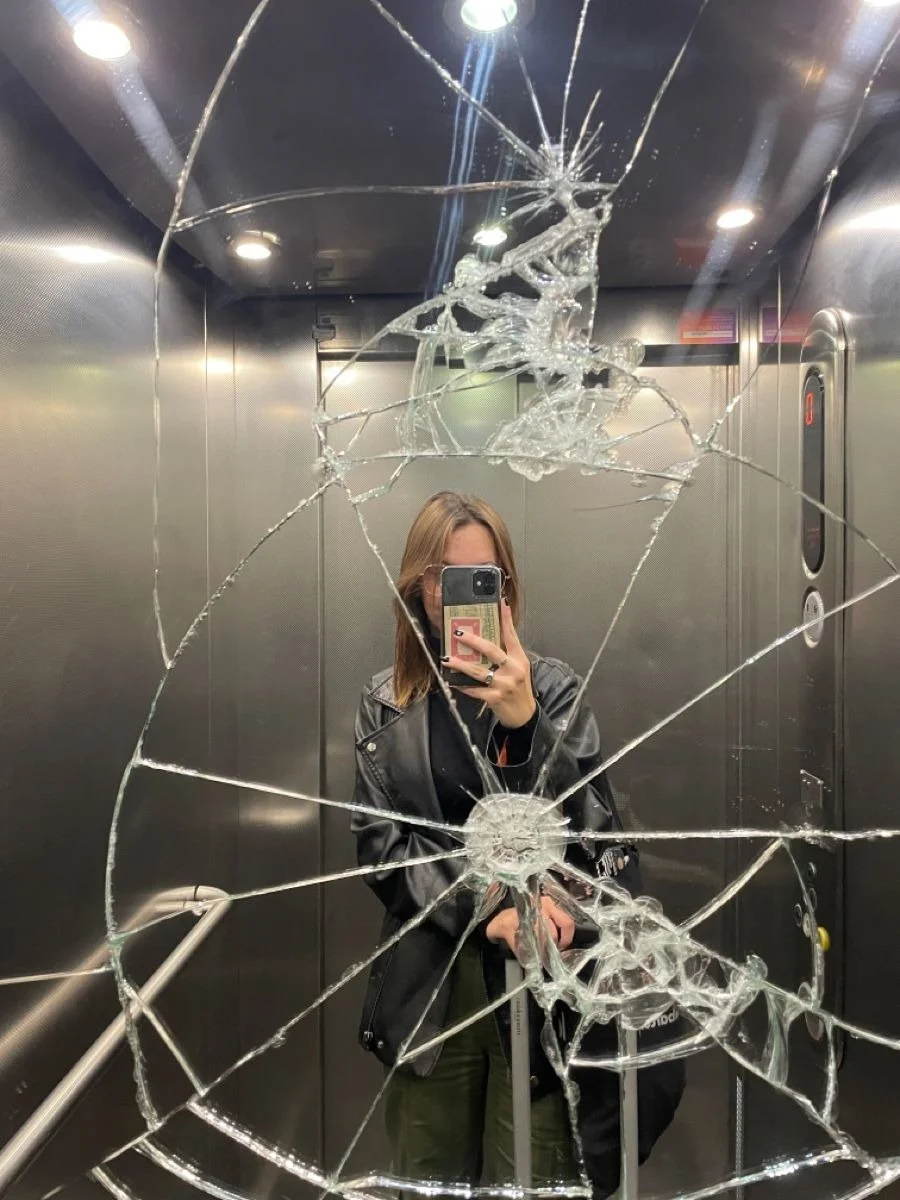
Woman taking a selfie in front of a broken mirror.
Since the first front-facing phone cameras in 2003, taking and sharing photos of yourself has been hugely popular.
When “selfie” became Oxford Dictionaries’ Word of the Year in 2013, people predicted that the phase wouldn’t last long, or perhaps that a complete cultural narcissistic collapse was coming. Well, it looks like selfies are here to stay for now, and culture has continued more or less!
Why We Love Selfies
We enjoy selfies when they capture a moment, a place, and a time. They say not only “this place is nice”, but
“I was here, with these friends, and I enjoyed it”.
Possibly the world’s most well-known selfie was posted by Ellen DeGeneres at the 2014 Oscars. It featured 12 A-listers crammed into one frame, taken by the long arm of Bradley Cooper and became the most retweeted tweet ever. We enjoyed seeing all these actors whom we felt we sort of knew, all in one place, being friends with each other, having fun.
Why did people love it so much?
It captured something joyous, and maybe even glorious. And in our best selfies, we feel like we’ve captured that too. Hair and make-up done, correct camera angle, beautiful sunset, best friends, perfect! It may have taken 20 shots to get there, but we choose the best, and upload it.
The No-Makeup Challenge
In 2014, the #nomakeupselfie started trending. It was a mini-backlash against the carefully curated images we share of ourselves, encouraging people to share a real photo of themselves as they are without make-up. Celebrities got on board with the trend, though it soon became clear that many of them lied about the no makeup aspect! For some women, there was just too much at stake to share such a vulnerable image.
What happens when our selfie-taking only serves to highlight our flaws?
When I’m taking a selfie I notice that…
My hair doesn’t look right
My nose is too big
That spot on my chin is huge
My eyebrows aren’t symmetrical!
When I receive a group photo, I’ll always check myself first – do I look fat? Are my eyes shut? But with a selfie, I can re-pose and re-take until I’m happier. And if it doesn’t work, I can always tweak it afterwards. Facetune and Snapchat can shrink my nose, enlarge my eyes, smooth my skin, and slim my face down.
When Life Isn't Instagram-Worthy
But sometimes the flaws are more than just skin-deep. What if my life isn’t that Instagram-able? Selfies are meant to be celebratory –
“Here I am receiving the Nobel Peace Prize .. for the second time!!”, “Here’s my gorgeous toddler giving me a kiss”
“Here I am enjoying a cocktail on a secluded beach.”
But what if my life is more like “Here I am in the hospital again” “Here’s my toddler throwing his breakfast at me”, and “Here I am doing the washing up late at night”?
I’m glad my life isn’t being photo-catalogued when I’m shouting at the kids, not answering my friend’s texts, or responding sharply to my husband.
The Beauty and Brokenness of Selfies
Like most things in this life, selfies give and take away at the same time. They have the potential to be something joyful, that reveals the beauty of people, places and moments. But they’re also a window on our broken, flawed lives, and so they sometimes reveal pain and difficulty.
A Better Reflection
The Bible says humans are created in God’s image. We’re supposed to be like little pictures of what God is like, reflecting his glory like mirrors. But it also tells us that this isn’t the way the world is now. We’re now like smashed mirrors.
We’re still in God’s image, but we’re broken. In humans, we see glimpses of glory, a flash of light in a shard of mirror. But then the image breaks into a thousand pieces. We see the ugly reality of life alongside the glory. We want perfection, but we can never get there, not by looking at ourselves anyway.
Jesus is the only man who has perfectly reflected God’s image. He was only ever good, all the time. I don’t think his disciples followed him around with a camera, but if they had they would never have captured a cruel word, or an impatient action.
The Bible says instead of looking at ourselves for perfection, we can look to Jesus for renewal. He looks at us in our imperfections and loves us despite the mess we’ve made. And even more than that, he promises a future of perfection.
A perfect world, where the mirror-image of God in us won’t be broken any more. We’ll be the glorious people we were made to be, when we’re re-made by Jesus. We’ll be side by side with our creator forever. Now that sounds like the perfect selfie!
This blog was written by Alison Brewis for International Selfie Day 2026